The Lost Art Revival: Meet the People Teaching Your Neighbors to Fix, Grow, and Build Again
I want to make an argument that might sound a little contrarian at first: learning how to darn a sock or make a stock from kitchen scraps or diagnose a wobbly chair joint might be one of the most radical things you can do in 2025.
Hear me out.
For the better part of a century, the American economy has been structured around a simple premise: it's cheaper and easier to buy a new thing than to fix the old one. Convenience became a virtue. Specialization became the norm. And somewhere in the middle of all that, an enormous body of practical human knowledge — the kind that used to pass from grandparent to grandchild in kitchens and workshops and garden rows — quietly slipped away.
We are, as a culture, less capable of doing basic things for ourselves than any previous generation in American history. And I think, on some level, a lot of us feel that absence without quite being able to name it.
What We Actually Lost
Let's be specific, because the scope of this is worth sitting with.
Basic food preservation — canning, fermenting, drying — was once universal household knowledge. Today it's a niche hobby. Sewing and mending clothes was a standard life skill through the mid-20th century; now most Americans throw away garments with minor damage because they don't know how to fix them. The ability to build or repair simple wooden furniture, once common among men and women who grew up in rural or working-class households, has largely vanished from everyday life. Herbal medicine — not as a replacement for modern healthcare, but as a practical first-line relationship with common plants — was part of family tradition for most of human history and is now treated as fringe knowledge.
None of this is meant as nostalgia for a simpler time that probably wasn't as simple as we imagine. It's just an honest accounting of what we've traded away in the name of convenience.
The good news? People are noticing. And they're doing something about it.
The Fixers, the Growers, the Builders
Across the country, a loose but energetic movement of practical-skills revivalists is emerging. They're not waiting for schools or governments to act. They're just opening their garages, their kitchens, their community centers, and their backyards — and inviting people in.
Repair cafés are one of the more visible expressions of this. Modeled on a concept that started in the Netherlands, these are community events where volunteers with repair skills — electronics, textiles, bicycles, furniture — sit down with neighbors and fix things together. There are now hundreds of repair cafés operating across the US, and the model keeps spreading. The appeal isn't just the fixed item. It's the transfer of knowledge, the conversation that happens over a broken lamp, the moment when someone realizes they could have done this themselves.
Skill-share workshops are another growing phenomenon. These range from formal programs through community colleges and libraries to informal gatherings in someone's backyard where a person who knows how to make sourdough teaches ten people who don't. The barrier to entry is low. The impact, both personal and communal, is surprisingly high.
Then there are the individuals who've simply decided that what they know is too valuable to keep to themselves.
Portraits of the Modern Mentor
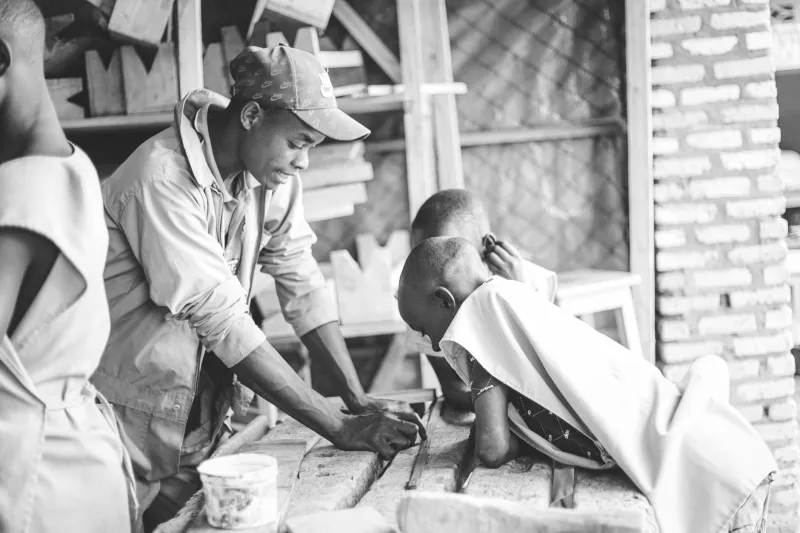
Take James, a 68-year-old retired carpenter in rural Tennessee who started hosting monthly "build something" sessions in his shop after noticing that none of his adult children knew how to use basic tools. Word spread. Now he has a rotating group of twenty or thirty people — ranging in age from teenagers to retirees — who show up on Saturday mornings to learn joinery, fix furniture, and, in James's words, "figure out that they're more capable than they thought."
"There's a look people get the first time they make something with their hands that actually works," he says. "It changes something in them. I'm not sure I can explain it, but I've seen it enough times to know it's real."
Or consider Fatima, a first-generation American in the Chicago suburbs who grew up watching her grandmother use plants from their garden to treat common ailments. She spent years feeling like that knowledge was somehow out of place in her modern American life. Then she started hosting herb walks in a local forest preserve and teaching neighbors to identify and use medicinal plants safely. The response overwhelmed her.
"People are hungry for this," she says. "Not because they want to replace their doctor. But because they want to feel less helpless. They want a relationship with the natural world that goes beyond just looking at it."
Why This Matters Beyond the Personal
Here's where I want to push the argument a little further.
When individuals learn practical skills and then teach them to others, something happens to a community that goes beyond the sum of its competencies. People who can do things together trust each other more. They have reasons to interact that aren't mediated by commerce or screens. They develop a shared sense of capability — a collective confidence that problems can be solved locally, with human hands and human knowledge.
That's not a small thing in a moment when many Americans feel powerless in the face of large, impersonal systems. The ability to fix your own chair, grow your own food, or make your own medicine isn't just practical. It's a quiet act of self-determination. And when you share that ability with your neighbor, it becomes something even more powerful: a community that can take care of itself.
Your Move
If you've been thinking about learning something — a craft, a skill, a practice that connects you to a longer human lineage of doing and making — I'd encourage you to stop waiting for the right moment and just start.
Find a repair café near you. Sign up for a fermentation class at your local library. Ask the person in your neighborhood who always has a gorgeous garden if they'd be willing to show you what they know. Offer your own skills to someone who needs them.
The lost arts aren't lost forever. They're just waiting for people willing to pick them back up — and pass them on.