When Elders and Young People Find Each Other, Everyone Wins
Two Empty Chairs
I want you to picture two people.
The first is 17. He's smart, capable, and completely unmoored — not sure what he wants to do after high school, not sure who to ask, not sure anyone in his life has the time or the answers. His parents are working two jobs between them. His school counselor has 400 students on her caseload. He's not in crisis. He's just... floating.
The second is 74. She spent 35 years as a master seamstress, raised three kids, buried a husband, and now lives alone in the house she's owned for four decades. Her children call on Sundays. She volunteers at church when she can. But most of her days are quiet in a way that has slowly started to feel less like peace and more like absence.
These two people exist in the same neighborhood. They have never met.
This is the gap that intergenerational mentorship programs are trying to close — and the results, when they succeed, are remarkable.
Two Crises, One Solution
Let's be honest about the scale of what we're dealing with.
Youth disengagement is real and growing. According to multiple studies, young Americans report higher rates of loneliness, purposelessness, and anxiety than previous generations — and lower rates of connection to community institutions, mentors outside the family, and long-term career vision. Many enter adulthood without a single trusted adult relationship outside their immediate family.
At the same time, senior isolation has become a genuine public health concern. The U.S. Surgeon General has explicitly named loneliness an epidemic, and older adults — particularly those who are widowed, retired, or living alone — are among the most affected. Social isolation in seniors is linked to cognitive decline, depression, and significantly shorter lifespans.
These two problems exist side by side in almost every American community. And they are, at their core, mirror images of each other: one group has experience, wisdom, and time; the other has energy, curiosity, and a desperate need for guidance. The math isn't complicated.
What Actually Happens When They Meet
Josephine Carter is 71 and spent her career as a registered nurse in Detroit. When she joined a formal mentorship program pairing retired professionals with high school students, she expected to offer practical advice. What she didn't expect was to be changed by it.
"I thought I was going in to give," she says. "But Marcus — my mentee — he started asking me questions nobody had asked me in years. About what I was proud of. About what I'd do differently. He made me remember who I was."
Marcus, now 19 and enrolled in a nursing program at a community college, credits Josephine with showing him a version of his future he couldn't see on his own. "She made it real," he says. "Not like a brochure. Like a person."
This dynamic — the unexpected mutuality of mentorship — shows up again and again in the research. Older mentors consistently report increased purpose, cognitive stimulation, and emotional wellbeing. Young mentees gain not just practical guidance but a sense of being seen and valued by someone with lived experience.
Programs Making It Work
Across the country, a patchwork of formal and informal programs is building these connections. Some are school-based. Some are run through libraries or community centers. Some are entirely grassroots.
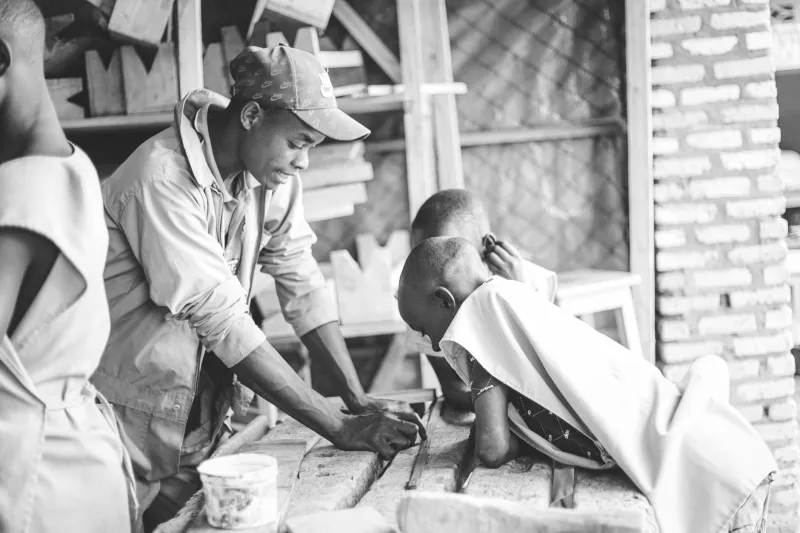
In Portland, Oregon, a program called Roots & Branches pairs retired tradespeople with teenagers interested in skilled work. Participants spend Saturday mornings working side by side on community projects — building garden beds, repairing furniture for donation, maintaining neighborhood trails. The work is the medium; the relationship is the point.
In Atlanta, a program embedded in a senior living community brings in middle schoolers for weekly "story sessions" where residents share memories and young people help record and archive them. What started as an oral history project has become something more intimate — a genuine friendship network that extends beyond the scheduled sessions.
"My granddaughter is in California," says one resident, 82. "But Isaiah — he's here every Thursday. He brings me updates on what's happening at his school like I'm his grandma. In a way, I am."
The Informal Version Is Just as Powerful
Not every meaningful intergenerational connection happens through a program. Some of the most transformative relationships form through proximity, happenstance, and a willingness to slow down.
Neighborhood settings — front porches, community gardens, local libraries — are some of the most fertile ground for these connections. When older and younger residents share physical space regularly, relationships form naturally. The challenge is that modern life has systematically reduced those shared spaces and the slow, unscheduled time that makes organic connection possible.
This is part of why so many community advocates are arguing for intentional design: neighborhoods and programs that create conditions for intergenerational contact rather than leaving it to chance.
What We Lose When We Don't Try
Here's what I keep coming back to: the cost of not building these connections.
When young people grow up without mentors outside their immediate family, they enter adulthood with a narrower map of what's possible. When older adults spend their later years without meaningful roles in the lives of younger generations, they lose one of the most powerful sources of purpose available to human beings.
We've built a society that segregates by age almost as thoroughly as it once segregated by race — different schools, different neighborhoods, different activities, different media. The result is mutual ignorance and mutual loss.
The good news is that the fix is simple, if not easy. It requires time, intentionality, and the willingness to sit across from someone whose life experience looks nothing like yours and decide that's a feature, not a bug.
Josephine Carter put it best: "Every young person deserves an old person who has time for them. And every old person deserves a young person who thinks they matter. Right now, we're not giving either of them what they need. But we could."